

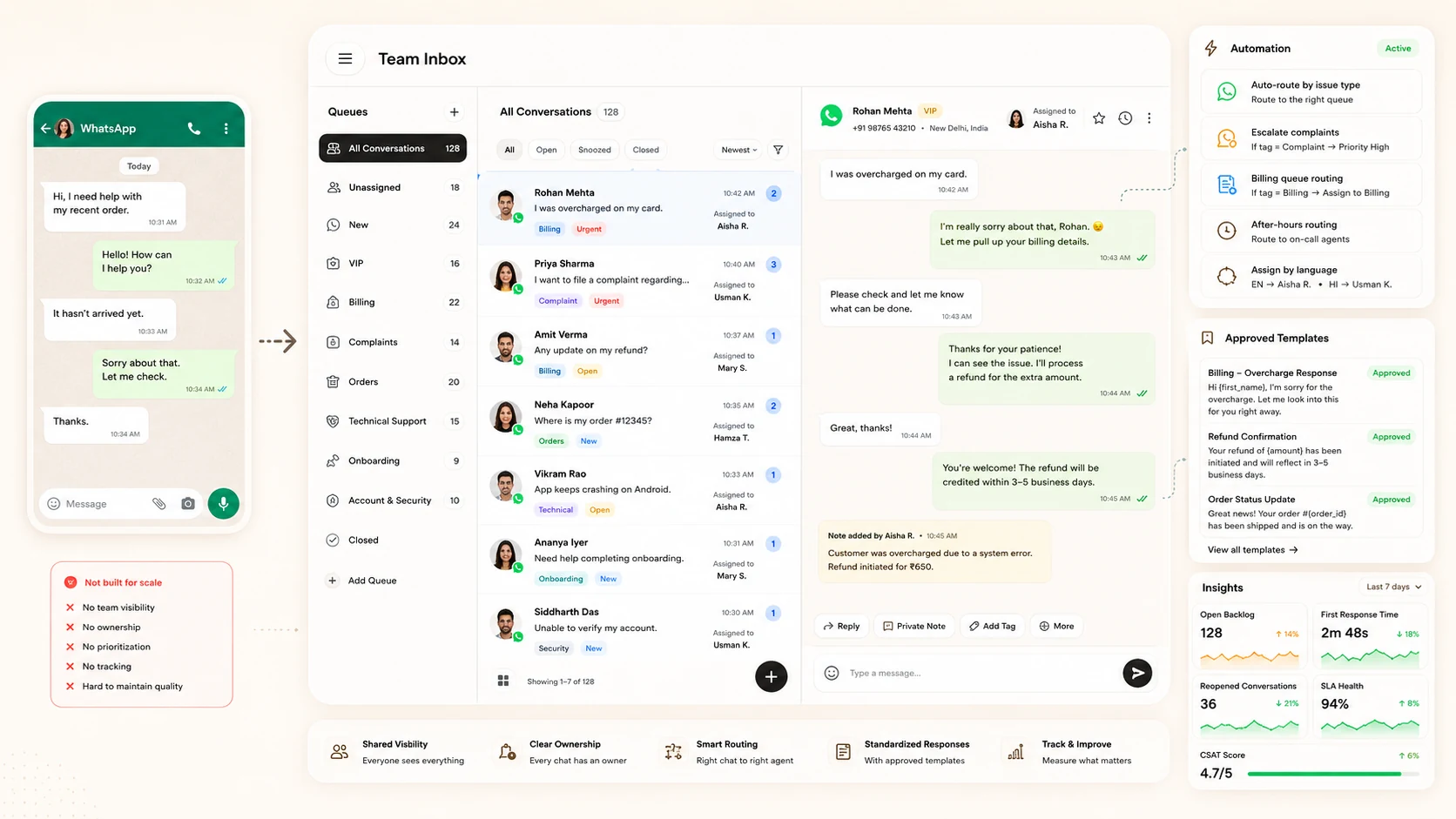

Many businesses assume support quality declines because the team is understaffed. In reality, quality often declines because the inbox itself was never designed for scale.
When a business handles support through disconnected phones or loosely shared access, problems appear quickly. One agent replies without context. Another misses a follow-up. Urgent conversations get buried under routine messages. Managers cannot see who owns what. Customers experience these failures as slow service, repetition, and inconsistency.
Scaling support on WhatsApp requires more than adding people. It requires an operating model.
The first requirement is shared visibility. Every support conversation should live in one place where the right team members can access message history, customer details, and current status. Support breaks down when context is trapped with individuals. It becomes stronger when the conversation belongs to the business rather than to a single device or agent.
The second requirement is clear ownership. Every open conversation should have an accountable owner, even if automation helps with routing. Without ownership, teams create a dangerous grey zone where everyone assumes someone else will respond. That is how simple issues turn into escalations.
The third requirement is prioritization. Not all conversations have the same urgency. A support inbox should make it easy to distinguish new inquiries, unresolved complaints, billing-related requests, and high-value customer issues. If all messages appear identical, the team has no operational signal for what must be handled first.
The fourth requirement is standardized handling. This does not mean robotic replies. It means the business should define how common scenarios are handled: first response, verification steps, escalation rules, handoff notes, and closure conditions. Templates and quick replies are useful here because they help teams stay clear and consistent without wasting time rewriting the same instructions.
The fifth requirement is routing logic. As volume grows, manual assignment becomes slow and uneven. Teams benefit from automatic routing rules based on queue, language, working hours, product line, or conversation type. Routing does not remove human judgment; it removes preventable delay.
The sixth requirement is response-time discipline. Teams need more than a vague intention to reply fast. They need visibility into open backlog, aging conversations, missed replies, and service-level expectations. Once support leaders can see those signals clearly, performance becomes easier to manage.
Good support inbox design also improves training. New agents onboard faster when conversation structure, handoff patterns, and response standards are visible in the system. Institutional knowledge stops living only in people’s heads.
This is also where teams often underestimate the role of analytics. If leaders do not know first-response time, reopen rate, queue volume, or handoff friction, they are managing support by instinct. That does not scale well. The inbox should not only collect conversations. It should expose the operating signals behind them.
Businesses often invest in support headcount before fixing support flow. That is expensive and inefficient. A better approach is to design the inbox properly first: shared visibility, ownership, routing, templates, and performance tracking. Once that foundation exists, adding more agents actually improves capacity instead of increasing confusion.
A scalable WhatsApp support operation is not built by telling the team to work harder. It is built by giving the team a system that makes quality easier to deliver.