


Businesses often treat WhatsApp templates as a compliance requirement. That is too narrow. Templates are really part of communication strategy.
They sit at the intersection of speed, consistency, approval rules, and customer experience. When they are planned well, they help teams follow up faster and communicate more clearly. When they are planned poorly, they create generic outreach, lower engagement, and unnecessary quality issues.
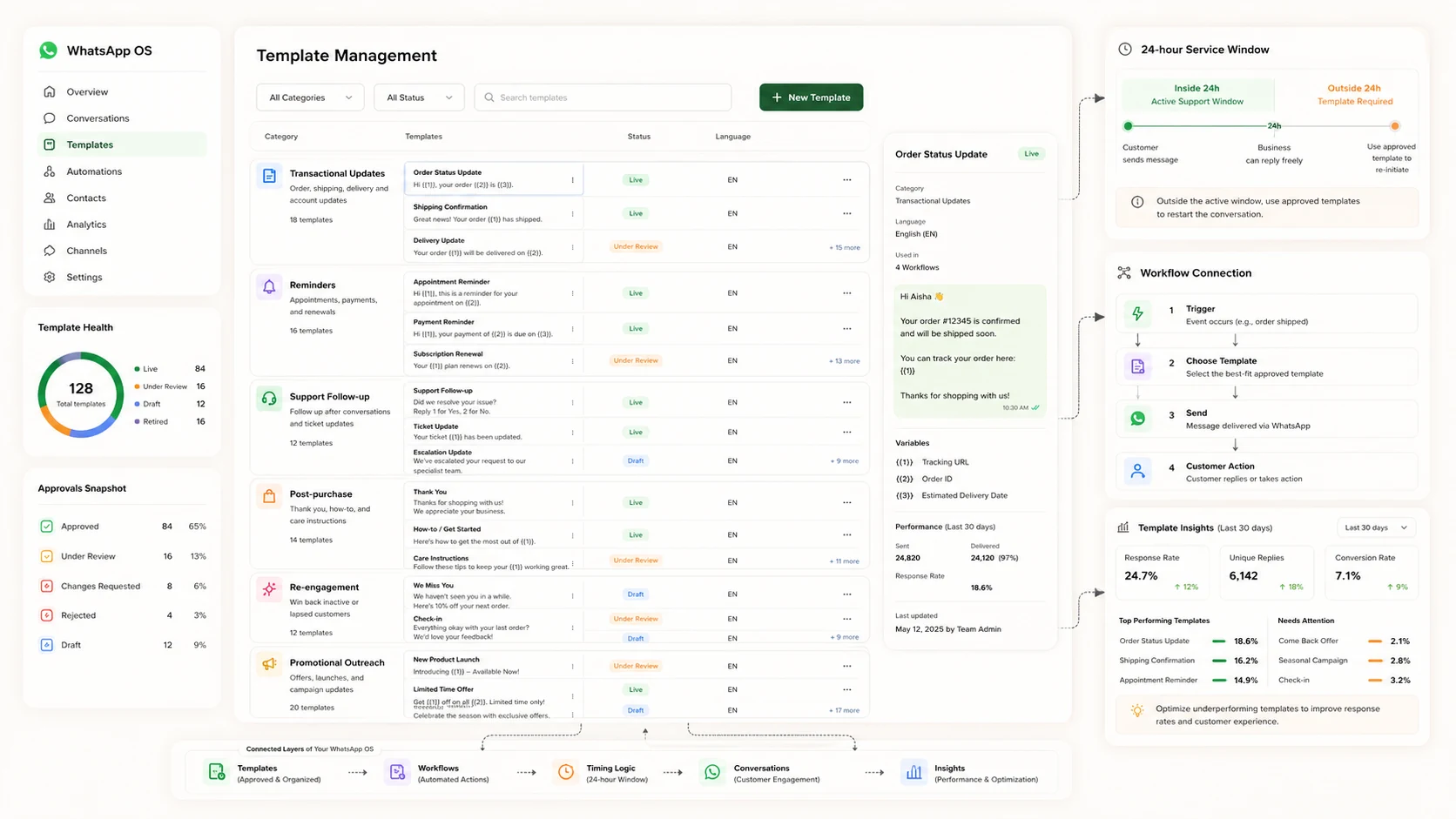
The first concept every team should understand is the 24-hour customer service window. Inside that window, the business has more flexibility to respond in the flow of an active conversation. Outside that window, a template may be required to restart the interaction depending on the scenario. That changes how sales, support, and retention teams should think about timing.
This is where many teams go wrong. They do not map message types to conversation states. Instead, they write a few templates, wait for approval, and use them too broadly. The result is predictable: messages feel irrelevant, response rates drop, and the team assumes templates are the problem.
Usually, the real problem is message design.
Good template strategy starts with use-case clarity. Templates should be separated by purpose: transactional updates, reminders, operational notices, post-purchase communication, re-engagement, support follow-up, and promotional outreach. These are not interchangeable. Each one has a different timing logic, business goal, and tone requirement.
The next layer is quality. A template should not exist just because a team needs to send something. It should exist because there is a repeatable communication moment that customers genuinely benefit from. If the message would feel interruptive, vague, or low-value to the customer, rewriting the copy is not enough. The use case itself may be weak.
This is why the best templates are usually simple. They are clear about what happened, what the customer needs to know, and what action is expected next. They do not try to carry too many ideas. They avoid clutter. They respect the customer’s time.
Teams should also manage template operations deliberately. That means tracking which templates are approved, which are under review, which are underperforming, and which should be retired. Template sprawl creates confusion quickly, especially when multiple departments build their own versions for similar events.
Another common mistake is separating templates from workflow design. A template is only one part of the customer journey. Its performance depends on when it is sent, to whom, after which trigger, and with what expected next step. The strongest teams do not ask whether a template is good in isolation. They ask whether it fits the communication flow.
For example, a reminder template may perform well if it is sent shortly before an appointment with a clear next action. The same copy may perform poorly if sent without context, too early, or after the customer has already disengaged. Execution matters as much as wording.
Approval and policy compliance are important, but they should not be the end goal. The real goal is to build a template system that supports revenue, support efficiency, and trust without pushing customers into fatigue or irrelevance.
Businesses that understand the 24-hour window, segment template use cases carefully, and connect templates to real workflows usually see much better outcomes than teams that treat templates as mass-send assets.
WhatsApp templates work best when they are part of an operating system, not just a message library.