

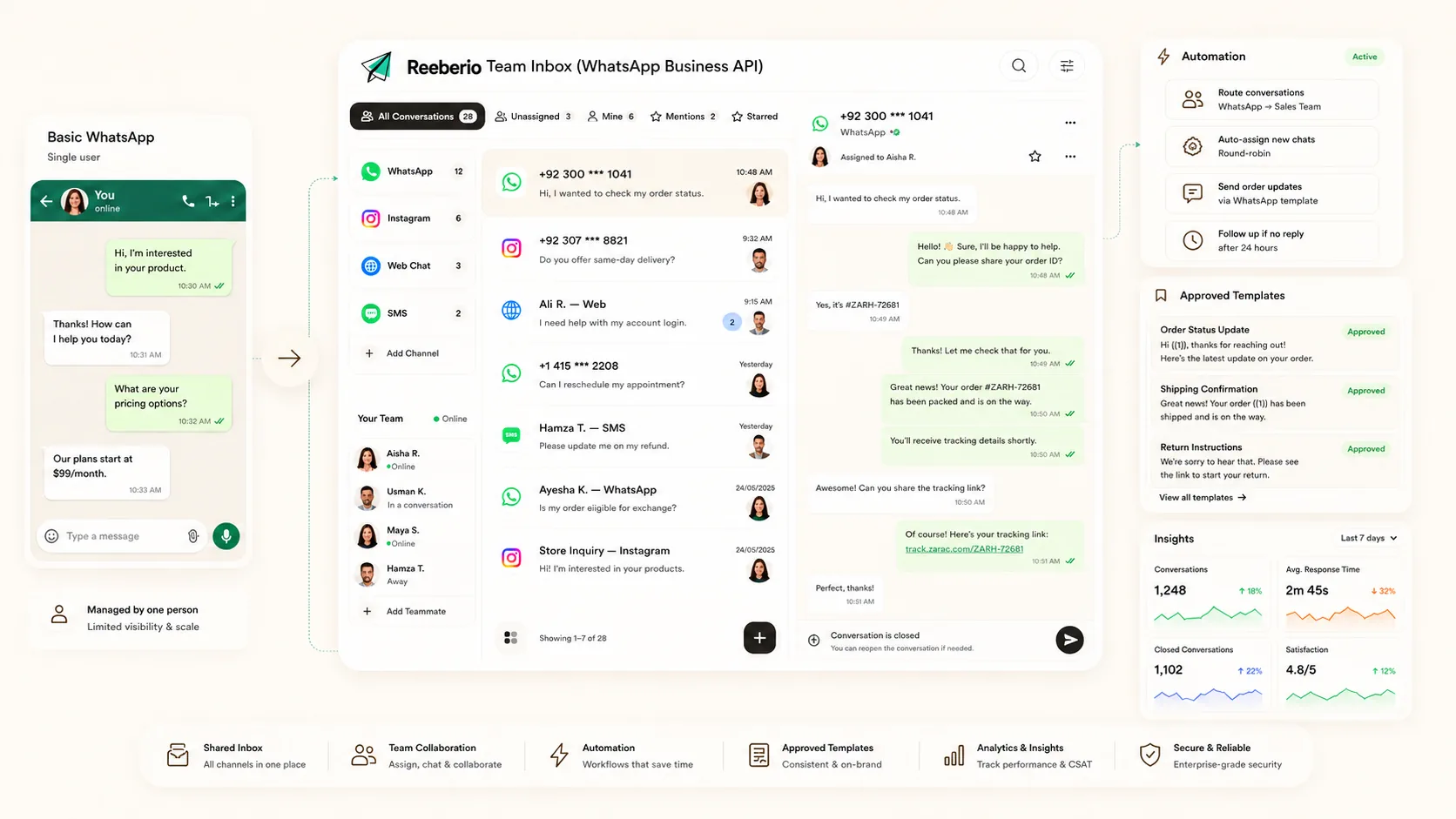

For many businesses, WhatsApp starts as a simple communication channel. A founder, support executive, or salesperson begins using the WhatsApp Business App because it is quick to set up and familiar to customers. At that stage, speed matters more than process, and the app does the job.
The trouble starts when the business grows but the operating model does not.
Leads increase. More conversations stay open at the same time. Customers expect faster responses. Multiple agents need access. Managers want visibility into who replied, who followed up, and which conversations are still pending. That is the point where businesses stop asking, “Can we use WhatsApp?” and start asking, “Can we run WhatsApp properly as a team?”
That distinction matters because WhatsApp Business App and WhatsApp Business API are built for different stages of maturity.
The app is useful for small-scale communication. It works well when one person or a very small team handles customer chats and when the business does not need deep workflow control. It is practical, simple, and inexpensive. But simplicity comes with limitations. Conversation ownership becomes unclear, reporting is minimal, integrations are limited, and operational discipline depends too much on people remembering what to do next.
The API changes that model. It is not merely a larger version of the app. It is the foundation for a structured communication system. With the API, businesses can connect WhatsApp to a team inbox, use approved templates, automate repetitive steps, route chats intelligently, connect external tools, and track performance in a more meaningful way.
This becomes important earlier than many teams expect.
If conversations are being handled by several people, you already have a coordination problem. If customers are not getting consistent follow-ups, you already have a process problem. If leadership cannot tell whether WhatsApp is helping sales, support, or retention, you already have a measurement problem. These are not communication issues alone. They are operational issues, and the free app is not designed to solve them.
The practical way to evaluate the shift is to look at five signals.
First, multiple agents need access to the same conversations. Second, response speed now affects revenue or customer satisfaction. Third, your team repeats the same messages and follow-ups every day. Fourth, you need integration with CRM, sheets, e-commerce systems, or internal tools. Fifth, you want proper visibility into activity, performance, and accountability.
If those conditions exist, the question is no longer whether the app still works. The better question is whether it is creating hidden friction that will keep growing with volume.
This is where a proper WhatsApp platform on top of the API becomes valuable. It gives the team a shared operational layer: centralized inbox, templates, workflows, permissions, analytics, and integrations. Instead of treating WhatsApp like an informal chat tool, the business starts treating it like a real customer communication channel.
That shift usually improves three things at once. Teams respond faster because context is visible. Managers gain control because work is trackable. Customers get a smoother experience because communication feels coordinated rather than fragmented.
The WhatsApp Business App is not the wrong tool. It is simply the wrong tool for businesses that have already outgrown single-user operations. Once the business depends on WhatsApp for sales, support, onboarding, or retention, the safer long-term move is to adopt the API and run it through a system built for teams.