

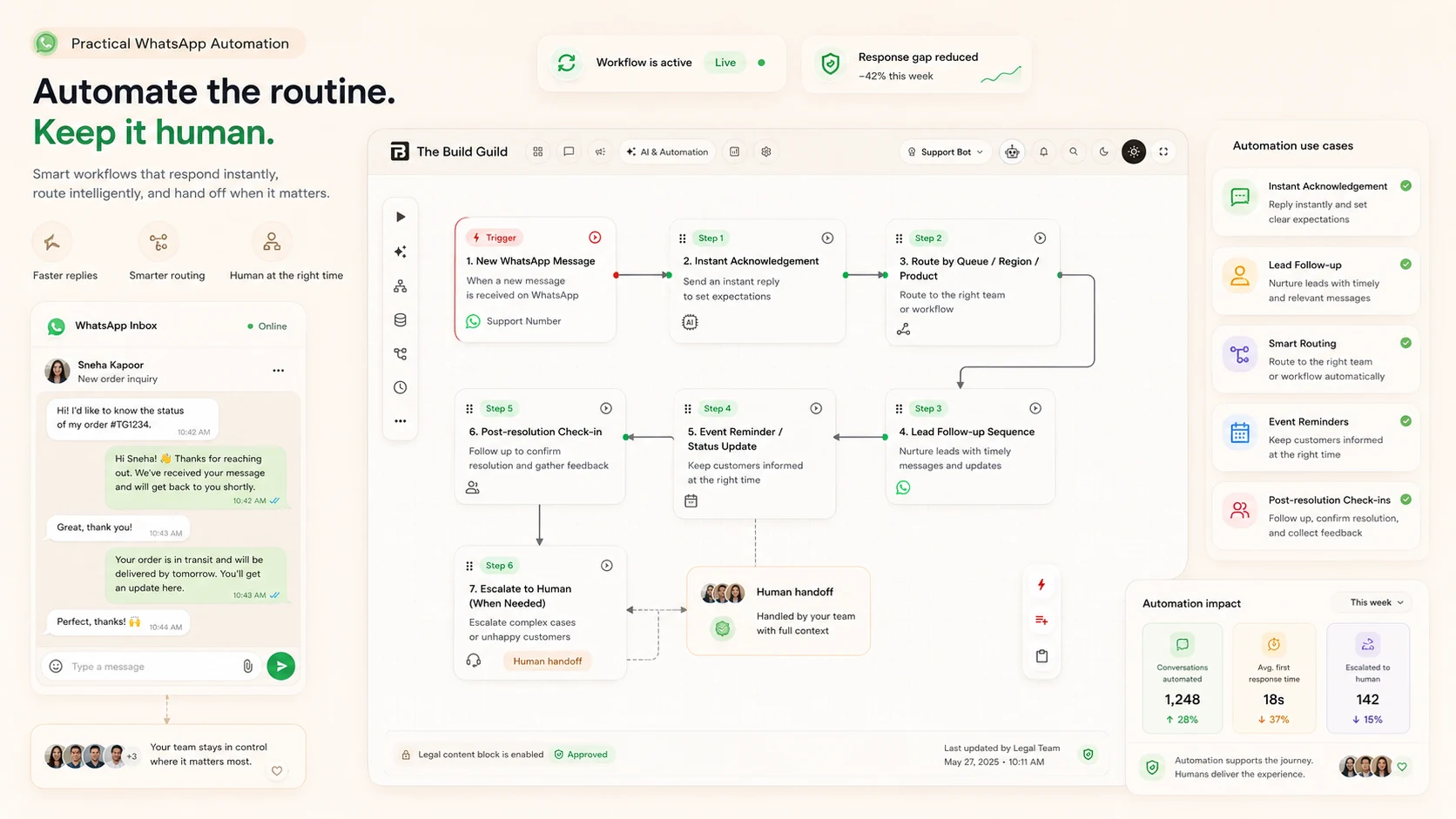

Automation is often discussed in extremes. Some teams avoid it because they are afraid customer conversations will feel cold. Others over-automate and create rigid message flows that sound artificial. The right approach sits in the middle.
Strong WhatsApp automation does not try to replace every human interaction. It removes repetitive operational work so people can focus on moments where judgment, empathy, and persuasion matter more.
Here are five automations that usually create immediate value without damaging the customer experience.
The first is instant acknowledgement for inbound inquiries. When a customer sends a first message, silence feels risky. A short, well-written acknowledgement reassures them that the business has received the inquiry and sets the expectation for next steps. This is useful in both support and sales because it closes the response gap without pretending to solve the full request automatically.
The second is lead follow-up sequencing. Sales teams frequently lose opportunities not because leads are poor, but because follow-up is inconsistent. If a lead does not reply after an inquiry, the system should be able to trigger a measured follow-up sequence. The key is restraint. Good follow-up automation is relevant, time-bound, and easy to stop once a person replies or opts out.
The third is intelligent conversation routing. Routing is one of the best places to automate because customers do not benefit from waiting while internal teams decide who should respond. New inquiries can be assigned based on queue, region, product line, or business hours. That reduces delay without changing the quality of the human conversation that follows.
The fourth is event-driven reminders. Businesses repeatedly need to send appointment reminders, payment reminders, onboarding prompts, renewal nudges, and status updates. These messages are operational by nature, which makes them ideal for automation. When triggered properly, they reduce manual effort and also reduce customer confusion.
The fifth is post-purchase or post-resolution check-ins. Once a sale is completed or a support issue is resolved, teams often miss the chance to continue the relationship. A short automated check-in can gather feedback, encourage the next step, or reopen assistance if needed. This works especially well when the message is narrow and clearly tied to the previous interaction.
All five of these automations share one principle: they support the journey rather than trying to dominate it.
There are also clear warning signs that automation is being used badly. Messages are too frequent. Tone is generic. Every customer receives the same sequence regardless of context. The system keeps sending reminders after a person has already replied. Teams use automation to compensate for weak process design rather than to improve a strong process.
The operational standard should be simple. Every automated message should answer three questions: why is this being sent, why now, and what should happen next? If the answer is unclear, the automation probably should not go live yet.
Well-designed WhatsApp automation creates breathing room for the team. It reduces queue friction, improves timing, and protects follow-up quality. Most importantly, it does that without making customer conversations feel synthetic.
Automation should make your business more reliable, not less human.