

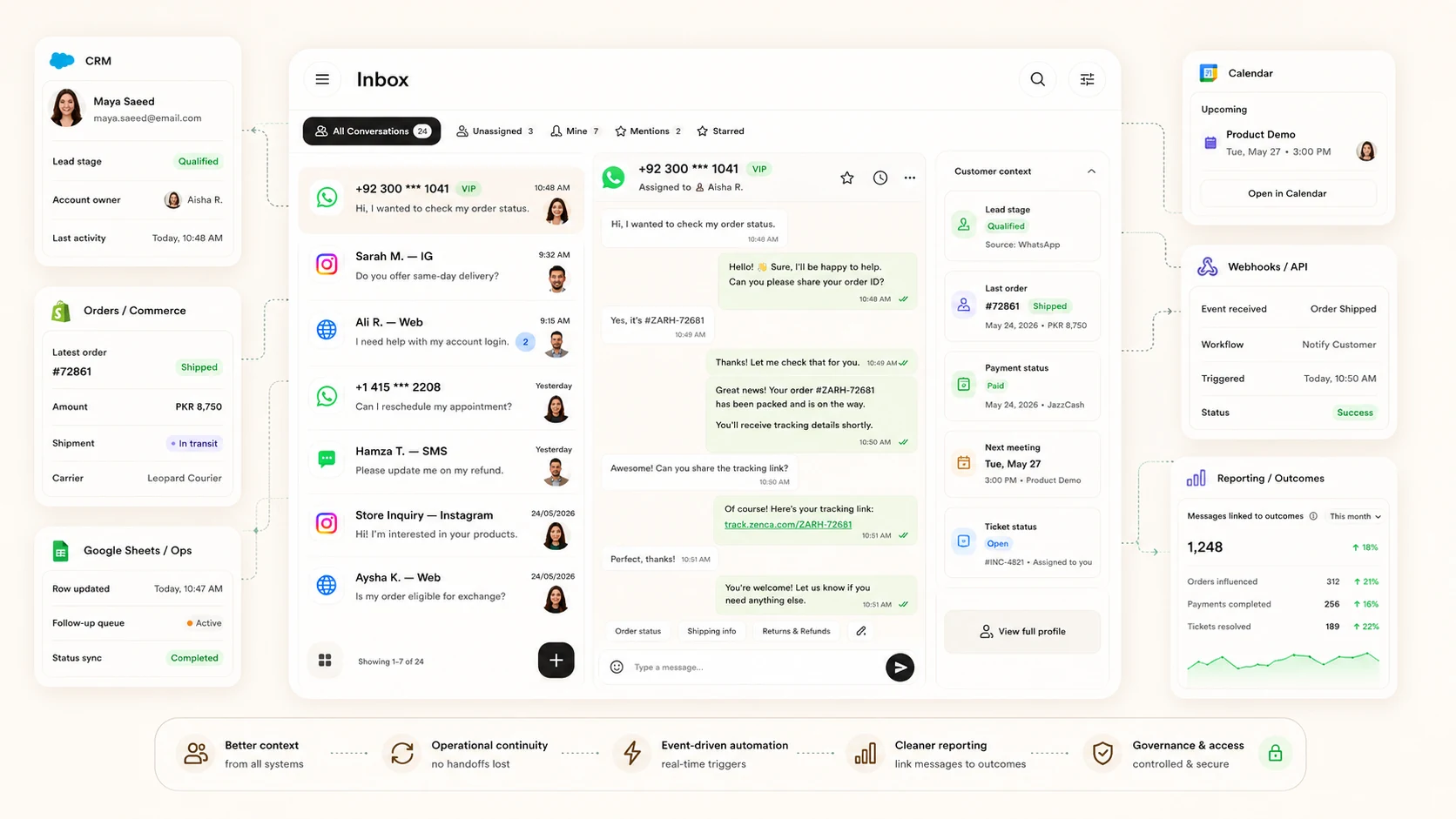

Many businesses improve their WhatsApp operations but still leave one major weakness untouched: the inbox is disconnected from the rest of the business.
That creates a ceiling quickly.
If agents cannot see customer status, order history, lead stage, or prior actions from other systems, they operate with partial context. They may still reply quickly, but not always intelligently. That gap shows up in repetitive questions, unnecessary handoffs, weak follow-up, and poor reporting across teams.
An integrated WhatsApp stack changes that from the ground up.
The first benefit is context. When WhatsApp is connected to CRM, the team can see where the customer sits in the pipeline, what the last activity was, and whether the conversation belongs to sales, onboarding, retention, or support. That makes replies more relevant and reduces internal guesswork.
The second benefit is operational continuity. Customer communication does not start and end inside the chat window. It is tied to orders, meetings, tickets, subscriptions, invoices, campaigns, and tasks. If WhatsApp is isolated from those systems, people compensate with manual copy-paste work. That is slow, error-prone, and difficult to scale.
The third benefit is better automation. Automation becomes much more useful when it can respond to business events rather than only to chat events. An order placed, a payment delay, a meeting booked, a support case closed, or a lead updated in CRM can all become triggers for relevant WhatsApp actions. This creates communication that feels timely because it is anchored in actual business activity.
The fourth benefit is cleaner reporting. Leadership rarely wants to know only how many WhatsApp messages were sent. They want to understand what those conversations influenced. Did they move leads forward? Did they reduce support backlog? Did they improve post-purchase engagement? That kind of reporting becomes possible only when the messaging layer is linked with the systems where outcomes are recorded.
There is also a governance benefit. Integrated systems reduce the amount of customer data trapped in personal devices, informal spreadsheets, or team memory. That improves consistency and makes compliance, access control, and historical visibility easier to manage.
For many teams, the most practical starting points are CRM integration, spreadsheet-based ops, order or commerce triggers, calendar coordination, and webhooks for custom workflows. These do not require a fully complex architecture on day one. But they do move the business away from treating WhatsApp as a standalone tool.
This is especially important for companies trying to build repeatable revenue and service processes. A disconnected inbox can still generate effort. An integrated inbox creates leverage.
The strongest WhatsApp setups are not just good at chat. They are good at moving information and decisions across the rest of the business. That is what turns messaging from a channel into infrastructure.
Businesses that connect WhatsApp to CRM, commerce, and internal workflows usually discover the same thing: conversations become more relevant, teams become more efficient, and the business gains much better visibility into what the channel is really doing.